
Storytelling isn’t just reserved for bedtime tales or entertainment; it’s a powerful tool that lies at the heart of every successful business narrative. For Founders navigating the competitive landscape, the art of storytelling isn’t just an added skill; it’s a strategic necessity. Crafting a compelling narrative has become a cornerstone for Founders seeking to captivate investors, engage customers, and inspire teams. However, mastering this art can be a challenge. In this blog post, we’ll delve into the impact storytelling can have on founders and why getting the guidance of a skilled storytelling coach can be a game-changer in the journey toward business success.”
A storytelling coach plays a pivotal role in honing a founder’s ability to craft narratives that transcend mere facts and figures. They guide founders in developing a compelling story that weaves together the essence of their vision, values, and mission. Through personalized coaching, founders can learn to communicate their ideas with clarity, persuasion, and memorability. This goes beyond a traditional pitch; it involves creating a narrative that captivates the audience, making them not just understand the information but feel connected to it on a deeper level.
Here are 5 ways in which Start-up founders can benefit from a storytelling coach:
#1 Developing Confidence & Presentation Skills
The ability to confidently and effectively present ideas is crucial for the success of founders, especially in situations like public speaking and pitching to various stakeholders. A storytelling coach can significantly contribute to improving presentation skills, reducing anxiety, and boosting confidence.
CRAFTING A CLEAR & COMPELLING NARRATIVE
A storytelling coach works with founders to craft a clear and compelling narrative for their presentations. This involves not only organizing information logically but also incorporating storytelling elements that engage the audience. By having a well-structured and interesting story to tell, founders can feel more confident in delivering their message.
PERSONAL CONNECTION WITH THE CONTENT
Confidence in presenting often comes from a genuine connection with the presented material. A storytelling coach helps founders develop a personal connection to their story. This involves identifying key elements of the narrative that resonate with the founder on a personal level. When a presenter is genuinely invested in the content, it translates into confidence during the presentation.
OVERCOMING ANXIETY THROUGH REHEARSAL
Anxiety in public speaking is natural, but a storytelling coach assists founders in managing and overcoming this anxiety through focused rehearsal techniques. By practicing the delivery of the narrative, founders become more familiar and comfortable with the material. The coach provides constructive feedback, helping the founder refine their delivery and build confidence through preparation.
CREATING A POSITIVE MINDSET
Confidence is closely tied to mindset. A storytelling coach works with founders to cultivate a positive mindset about presenting. This involves reframing thoughts about potential challenges, embracing mistakes as learning opportunities, and focusing on the value of the message being delivered. A positive mindset contributes significantly to the overall confidence of the presenter.
#2 Building a Deep Connection with Audience
Storytelling helps create an emotional connection with the audience. Whether it’s investors looking for passion and commitment or customers seeking a solution to their problems, a well-crafted story can engage and resonate with the audience on a deeper level.
FOSTERING EMPATHY
Storytelling has a unique ability to evoke emotions. When founders share authentic stories that reflect their journey, challenges, and triumphs, they humanize their brand. This human touch fosters empathy, allowing the audience to relate to the founder on a personal level. Investors are not just investing in a business; they are investing in the person behind the business. Customers, likewise, are drawn to brands that resonate with their values and experiences. A storytelling coach can guide founders in identifying and articulating these pivotal moments that evoke empathy and create a sense of shared experience.
BUILDING TRUST
Trust is the bedrock of any successful business relationship. Through storytelling, founders can build trust by showcasing transparency, authenticity, and vulnerability. When a founder shares the story of their entrepreneurial journey, including the setbacks and lessons learned, it demonstrates honesty and resilience. A storytelling coach can provide constructive feedback to ensure that these narratives are presented in a way that enhances trust and credibility, reinforcing the founder’s integrity in the eyes of the audience.
ALIGNING WITH AUDIENCE VALUES
A well-crafted story can also align with the values and aspirations of the audience. Investors, for instance, may be drawn to stories of innovation and societal impact, while customers may connect with narratives that address their pain points and provide meaningful solutions. A storytelling coach helps founders tailor their stories to align with the values and expectations of their specific audience segments, ensuring a more profound and resonant connection.
CAPTURING ATTENTION
Stories have an inherent allure that captures attention. Whether it’s an anecdote about overcoming a hurdle or a narrative that illustrates the genesis of a revolutionary idea, storytelling compels the audience to lean in and listen. A skilled storytelling coach assists founders in identifying the narrative elements that are most likely to resonate with their target audience. By understanding the audience’s aspirations, concerns, and motivations, founders can tailor their stories to align with these factors, creating a more profound and lasting impact.
#3 Communicating your Differentiation
In a competitive start-up landscape, having a unique and compelling story can set a founder and their company apart. A storytelling coach can help founders identify and emphasize their distinctive narrative, helping them stand out in a crowded market.
DEFINING THE UNIQUE VALUE PROPOSITION
Every startup has a unique value proposition, and a storytelling coach can assist founders in crystallizing and communicating this distinctiveness. By delving into the core of what makes the product or service exceptional, the coach can help identify narrative elements that emphasize the uniqueness. Whether it’s a revolutionary technology, a novel approach to solving a problem, or a founder’s personal journey that inspired the venture, a storytelling coach can guide the founder in articulating these aspects in a way that resonates with the target audience.
AMPLIFYING THE FOUNDER’S VOICE
Founders often play a central role in the identity of a startup. Their vision, passion, and personality can become powerful differentiators. A storytelling coach works with founders to amplify their voice in a way that aligns with the brand story. This might involve integrating personal anecdotes, showcasing the founder’s motivation, or highlighting unique perspectives. By doing so, the founder becomes not just the face of the company but a compelling character in a narrative that distinguishes the startup.
#4 Building Brand Identity
Storytelling is an essential component of brand-building. Start-ups need to establish a strong brand identity from the outset, and a storytelling coach can assist in crafting a narrative that aligns with the brand’s values, mission, and culture. Startups often have distinct cultures and personalities that set them apart. Whether it’s a culture of innovation, a commitment to customer-centricity, or a playful and dynamic atmosphere, a storytelling coach assists founders in translating these cultural aspects into a narrative. This narrative, when effectively communicated, humanizes the brand, making it relatable and appealing to the target audience. It goes beyond product features to showcase the ethos and personality that define the startup.
Also, read this article in Forbes Magazine on 4 Secrets of Storytelling For Business Impact
#5 Pitching for Funding
Fundraising is a critical aspect of start-up growth and storytelling has a crucial role to play in 3 ways:
CREATING AN EFFECTIVE ELEVATOR PITCH
In the fast-paced world of fundraising, having a concise and memorable elevator pitch is crucial. A storytelling coach works with founders to distill their narrative into a succinct and impactful pitch that can be delivered within a short timeframe. This elevator pitch, when crafted effectively, serves as a powerful tool for sparking initial interest and opening the door to more in-depth conversations with investors.
BUILDING THE PROBLEM SOLUTION NARRATIVE
A successful pitch not only outlines the business model but also communicates a clear understanding of the problem the startup is solving. A storytelling coach guides founders in emphasizing the problem-solution narrative, making it relatable and compelling. By framing the pitch in a way that highlights the pain points of the target market and how the startup provides a viable solution, founders can effectively capture the interest and confidence of potential investors
BUILDING CREDIBILITY
Trust is a critical factor in fundraising. A storytelling coach helps founders build credibility by strategically integrating key milestones, achievements, and the lessons learned from challenges into the pitch. This storytelling approach demonstrates not only the potential of the business but also the resilience and adaptability of the founding team. Investors are more likely to have confidence in a startup that can articulate a credible and well-rounded narrative
CREATING A LASTING IMPRESSION
Fundraising pitches are numerous, and making a lasting impression is essential. A storytelling coach ensures that the pitch is not just informative but leaves a memorable impact on investors. Through the artful use of storytelling techniques, founders can create a pitch that stands out, making them more likely to be remembered and considered for investment.
In conclusion, storytelling is a vital skill for start-up founders in various aspects of their entrepreneurial journey, from pitching to investors and customers to building their brand identity and overcoming challenges. A storytelling coach can provide valuable expertise and guidance to help founders effectively communicate their vision and achieve their business goals.
So, embrace the storyteller within you, and watch your startup story become the talk of the town!
To know more about TransforMe’s Storytelling offering, click here.
If you would like to know more about how we can help your start-up or organisation through Storytelling, write to us at connectATtransformelearning.com.
Securing stakeholder buy-in for Women Leadership Programs is critical in advancing gender diversity and promoting a more inclusive and equitable workplace. The importance of this support cannot be overstated, as executives hold the power to allocate resources, set strategic priorities, and shape organisational culture. Challenges can emerge when attempting to gain their commitment. Executives may be preoccupied with other pressing concerns, unconvinced of the business case for women’s leadership, or simply unaware of the potential opportunities.
How can People leaders build a business case for women leadership programs in their organisation? Why does women leadership continue to lag behind, what are some of the ground challenges that keep organisations from committing fully or scaling their Gender Equity efforts?
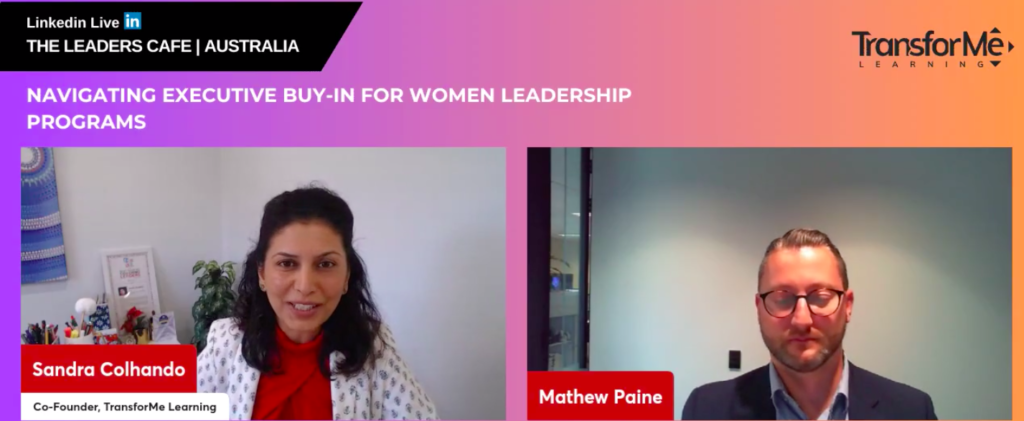
For our November 2023 edition of The Leaders’ Café, we had a special guest – Mathew Paine, a distinguished leader with over two decades of experience in human resources, organisational culture, and fostering women’s leadership. As the Executive General Manager – People & Culture at the Australian Financial Complaints Authority, Mathew is passionate about creating safe, inclusive, and productive workplaces where women can thrive and he shared some incredible insights on this topic with us.
Summary
- There are 3 key challenges for women with career progression – 1. Women have greater carrying responsibilities outside of work, therefore, it’s the woman who have to sacrifice their career for child-caring responsibilities 2. Women apply less frequently for roles than men 3 Women are more likely to doubt their skills and the chance of getting a role
- Every leader must ask – does our workforce represent the community that we serve? Australia, in particular, is a very diverse country. And if we don’t see the diversity inside the organisation, and we’re providing a service to the general population, something’s not right. So we need to start from a data-led approach to gender equity or DEI at large
- Mentorship and Sponsorship – Women are over-mentored, but they are under-sponsored, there are a lot of opportunities for women to upskill a key support that women leaders need today is to have somebody open the door, use the network and get them the position that they deserve
- Business case for Gender Equity beyond profitability – In 2024, the Workplace Gender Equality agency will be publicly publishing the gender pay gap of every organisation, not government, but all private organisations with more than 100 employees. And whilst there’s probably some, some of those organisations that do have only males at the top, and there could be females that are more junior levels that will just showcase even more the gap between the genders the pay gap between the genders. So there’s a real business benefit of making sure that organisations are, first of all measuring what the pay gap is, but then analysing their data and looking at what they can do because organisations are also going to be under stricter media scrutiny and need to be mindful of brand reputation risks they run
- With the economic slowdown and budget cuts, why organisations need to keep women leadership on their agenda – Reputation and Brand are crucial – they can have a huge impact on budgets, as well as turnover, lack of diversity and leadership can also lead to missed business opportunities. It could be a limited talent pooling or the brand and the reputation of the organisation. If it’s very male centric, that it may be that women just don’t want to go and work there. And that’s becoming more and more popular in Australia, where the employee makes a choice as to where they would like to work. And so they should, and if they’re not seeing the diversity or the ethics, or the values that they adhere to, personally, then they just won’t go there. So that’s going to have an impact also on profitability. Ultimately, shareholders, particularly for the public listed companies, they expect a shareholder expects to see not just that an organisation is producing results and profits. But more and more we’re seeing shareholders wanting to see the ethical components, as well are upheld by the boards and the CEOs of organisations.
FULL TRANSCRIPT
Sandra Colhando: Thank you, Matt. I want to start with your story. You hold the Chief People Officer domain, the role and there’s so much that comes under it from employee engagement, recruitment, and retention to performance, productivity, etc. Why is DEI so important for you?
Mathew Paine: For me, it really is about creating inclusive workplaces that then create a positive brand in the eyes of consumers and employees. Research shows that having a diverse pool of talent also brings about a variety of perspectives and that really helps to foster innovation, creativity, and ultimately boosting employee satisfaction and retention. And particularly in the HR world, a lot of the metrics that we use could be around satisfaction or engagement retention. And ultimately they also lead to no greater profits. And there are certainly shareholders and boards that are very interested in in seeing those metrics.
Sandra Colhando: Beautiful. And I know you’ve had this rich two decades of experience to actually see that happen. See that fruit refine in terms of results? When we look at some data points, for example, WGEA released a data set where they say that while women make up half of employees, about 51%, only 19% of CEOs of women, why do you feel is there a gap? Or what? What can be done to bridge this gap?
Mathew Paine: Yeah, it’s an interesting conundrum. I think if we step it up, and we think about from a global perspective, the World Economic Forum, every year brings out the Global Gender Gap index. And that benchmarks the current state, in the evolution of gender parity across a number of dimensions. And I just had a look at that this week. And for 2023, the number one country in the world out of 146, that they measure is Iceland, they’re doing a huge amount of work there. Australia is ranked number 26, which for a developed country, I would hope that it’s higher than that. And looking at India, it’s 127. So there are some huge gaps there. And if things keep going, they’ve been doing this for about 10 years. At speed, it’s going to take 131 years to bridge that gap. So there needs to be some quite drastic measures and initiatives put in place. And then if we think about more, Australia, in the UK, there is a gender pay gap in Australia of over 20%, about 22.8% To be specific, and men are twice as likely to be in the top income bracket as women and about boards. Only one in five boards have gender balance. So when I was when I was working in the New South Wales Government, there was a behavioural insights project that was completed around career progression of that was in conjunction with the Public Service Commission. The results found that there were four key challenges for women with career progression. And they were that women report that there’s more barriers to career progression. That women have greater caring responsibilities outside of work, therefore, it’s the woman that work or they have to sacrifice their career for child caring responsibilities, or also women apply less frequently for roles than men. And women are more likely to doubt their skills, and the chance of getting a role. Meaning a male may see a job and think, yeah, well look I am just here, but I’m going to apply anyway. Whereas a woman from this research that we conducted, was more likely to doubt their skills. So I think if you think about all that, together, there are probably a number of factors that still are at play. And we hear a lot about bias and stereotypes. There may be lack of representation also, of females in more senior roles in organisations; therefore, women may not envisage themselves to be in those roles. It could be that there is a workplace culture, or there’s practices in place that may lead to women not wanting to do those roles. For example, if there’s a really long working hours culture, if there is inflexibility of the work structure, maybe there’s no hybrid working or a lack of flexible working, all of those things can and those practices can really impact on the way women work. And then of course, things like unconscious bias when it comes to recruitment and promotion. There was a study recently actually in Australia, where it was for people and it’s not just women, but those that are working remotely. Could be overseen or over overlooked when it comes to promotions because they’re not in the office. And I think that there’s an overlay there. And then you know, other things like work life challenges. And in Maybe there’s even a lack of accountability inside organisations, you know, not holding CEOs or boards to account. So there’s probably a lot there. But that’s, that’s what I think.
Sandra Colhando: Beautiful. I am making notes and there seems a huge laundry list of why and what is the gap. I know there is work happening but in all of this, sometimes it just feels it’s so overwhelming. Where do we start? What’s the first step we take? With your experience and the background that you have- we are looking at recruitment, productivity, looking at culture, we’re looking at accountability, what will be the first step to take to start building this culture of gender equity?
Mathew Paine: Yeah, I think, like, where we need to start is thinking about the organisation, whatever organisation it is that that our listeners are working at. And I have always asked the question – does our workforce represent the community that we serve? Australia, in particular, is a very diverse country. And if we don’t see the diversity inside the organisation, and we’re providing a service to the general population, something’s not right. So we tend to start from a data-led approach. And it’s important to understand the matrix and how many, what is the gender breakdown, there might be some other diversity, and demographics that also organisations can measure and track, and then there’s the intersectionality of those two. So, you know, that may not be that it’s just male and female. But then if we add on other intersections, like cultural and linguistic diversity, could be an employee with a disability, could be that they identify as having a different sexual orientation. So there are many different factors. But I thiny understanding the data of your workforce is important. And that also really sets the the roadmap of where it is that you would like to go, and what’s the gap, and then thinking about some initiatives of how to bridge that gap. But I think if you don’t start with some type of a benchmark, it’s you need to know where you’re going. But you also need to know where you’re starting from.
Sandra Colhando: Absolutely, you’re connection is breaking up a little bit. So I’m just quickly summarizing – what you’re sharing is, you know, we need to look at where the organisation is, how’s the organisation representative of the clients or customers they’re serving. And how can we add in the sections and the diversity and work from there? I think what connected deeply with me when you’re, when you’re sharing this is setting the roadmap firs, before we jump into various initiatives, you want to see, what’s the road map for me as an organisation, which could be very different for another organisation at the same time. And what’s my way around it? And why do I need to have that included in our values? I think when you talk about the environment and culture of an organisation; it shouldn’t just be a tick in the box. It shouldn’t be just because it makes top-line sense that’s important for business, but it needs to go much deeper to create that sense of belongingness and organisation. And the decision-makers typically have that when you say the roadmap, are the executives, are people sitting at the board at the C suite level. That brings me to the question I know in an interview with HRM, you talked about selling diversity, and equity inclusion to the C-suite as one of the most significant challenges in this field. What do you think of what key elements should, say people cultural leaders need to include in the business case for women’s leadership programme to secure executive buy-in?
Mathew Paine: Good question, I think and you touch there about organisational values. So you know, really that there is alignment to values that there is an alignment to the organizational goals and emphasise how women leadership programs can align with the broader goals of the organisation, could be around improving innovation, diversity, and market competitiveness. And also the quantifiable benefits, there’s a lot of research out there that shows that a more diverse organisation has higher profits than those that are less diverse. But I think also it’s understanding the talent pipeline that you have internally, and helping to define what those success metrics are. Anthere are’s probably there’s pros and cons to setting targets. I’ve worked in organisations that have and have not, and I’m happy to talk about that. But I think, like I’ve mentioned before, you really need to know where it is that you’re going, as an organisation, and put it in, I think we can probably see the biggest change when we do have metrics that we put in place for the C suite, the executive team. And I’ve seen also where they might receive their bonus could be tied to those or their pay increases could be tied to particular metrics. And it’s not just financial, but also diversity metrics.
Sandra Colhando: That’s interesting. And you also talked aboutthe pros and cons of setting targets. So in your lived professional experience, what could be a target that is a pro that makes sense organisation because it drives positive culture in making this change? And what could be a target? That could be a con, which you need to be careful, about because it may not be a driving impact. It’s a target, we’re moving in that direction, but it’s not driving the right.
Mathew Paine: Yes. Okay, so I’ll give you an example, when I worked in the New South Wales Government, the Premier of the State had set targets, under particular diversity targets for all employers in the public sector. So we were working towards 50% women in senior leadership roles. And then there were some other metrics for other diversity initiatives. So I think the positive there was that there was a goal, everybody knew where we were going. And those targets were set up to 2025. So it wasn’t just an immediate overnight initiative, there were, you know, well-executed planned approaches to several initiatives. But where I’ve seen these initiatives or targets fall is where the Why isn’t explained properly. Those that don’t identify in those particular demographics, then they may go for a role and feel that they didn’t get the role because of their gender or because their diversity doesn’t align with that. So I think there needs to be, you know, real merit behind recruitment and selection. But sometimes, through initiatives, particular programs that work, they can certainly help to develop people. So an example that I worked with in government was we had a few different initiatives. One was the women in the senior leadership mentoring programme. It was a specific programme, only aimed at women who had high potential to move into a leadership role. And they were mentored by another executive who had already reached that goal, who was already working at that level. And it was a 12-month programme. And it was extremely popular. We always had so many people that wanted to be on it, because they saw that there were real tangible outcomes. And it wasn’t that they were favoured, but through their mentoring relationships and also the education that they received, It helped to shape them to then on, on their own merit when they went for a role that they felt comfortable and were able to achieve the selection criteria. And another programme that we ran was the Open Doors programme and which was a career sponsorship programme. So the difference between mentoring and sponsorship is mentoring is more about being available and assisting and helping to mentor and coach whereas the sponsorship programme was opening doors, but very soon new executives, who are then able to use their own connections, to then open doors and connections to those people who were then able to grow and to develop and to really benefit from that and leverage those executives, senior leadership roles. So we certainly had great success with both of those programmes. And we’re able to see some demonstrable outcomes.
Sandra Colhando: Oh, those are great programmes you talked about, we keep talking about this, there be maybe enough mentorship, maybe women are over-mentored, but they under-sponsored. So happy to hear you talk about the open-door programme, because there are a lot of opportunities for women to upskill. But I think the biggest support that women leaders need that is to have somebody open the door, use the network, and get them the position that they deserve. What about skill building? Matt, what do you feel? Do we need a separate programme for women leaders for them to skill belt to reach those positions?
Mathew Paine: Well, the success that we had with the women in the senior leadership programme was also that every couple of months, there would be a skills development programme aimed at that cohort of women that were on the programme. So I think there was some great marriage in that, where women were able to come along and discuss some of the issues that they may be facing and hear from other women about how they’re overcoming that or in the groups that they’ve been allocated with their trainer, that they can unpack that. And some of it could be, you know, purely down to their own confidence. And other things might be around skills. But I have seen that particular programmes aimed at women have had great outcomes. Having said that, I’ve also seen other programmes where it’s mixed genders, and there are also great outcomes. So I think it will probably depend on the content of those skills programmes, but I’m certainly not adverse to them.
Sandra Colhando: Yeah, often, we are asked why we need to have a separate women leadership programme and why not a mixed gender and you’re right, there is merit for both. But I also feel they’re very unique challenges that women professionals go through, which are listed out beautifully earlier in our talk, whether it’s you know, carrying responsibilities as a doubt imposter syndrome, which sometimes a uniquely hire for that gender, and therefore having a program exclusively to take care of those challenges, helps in managing and not creating a safe space for them to feel we are not in it alone there other women professionals going through this challenge and this asset community that’s created for us to move ahead. What I wanted to talk about, and you shared some very interesting initiatives that you’ve run, especially with the NSW Government in terms of targets. What can we do when maybe you don’t have an organisation that has a very strong executive mind for women leadership? Let’s take an example. An organisation is already profitable, and doing really well. But there is very little gender balance of the leadership in the leadership’s executive C suite, how do you showcase the return on investment on women’s leadership to them?
Mathew Paine: Yeah, it’s a good question. I think, particularly these days, we’re seeing more and more media for and not always positive, sometimes negative media, where there are organisations that don’t have good gender balance or don’t have good diversity, particularly as they go higher. And especially in Australia, for the next year 2024, the Workplace Gender Equality agency will be publicly publishing the gender pay gap of every organisation, not the government, but all private organisations with more than 100 employees. And whilst there are probably some, some of those organisations that do have only males at the top, and there could be females that are more junior levels that will just showcase even more the gap between the genders the pay gap, I should say between the genders. So there’s a real business benefit of making sure that organisations are, first of all measuring what the pay gap is, but then analysing their data and looking at what they can o, because I havy no doubt that from next year, there will be quite a few media articles that will come out that won’t be positive in a variety of different organisations in Australia. But I think also, then it just goes back to thinking about Australia in particular, as well, actually, no, not just Australia, but globally, there’s an ageing population. So women’s economic workforce participation is becoming more and more important around the world. The more women that are working, and particularly moving into more senior roles, the bigger the impact it is for the economy, that of the country that they’re in, the more tax they pay, those taxes then have benefits for the whole country. So there’s, there’s real equity, measures them. And outside of that, it’s just the right thing to do. So I think from an ethical perspective, organisations these days have got a lot of measures around ethics and sustainability, and gender balance, particularly in senior roles should be on everyone’s agenda.
Sandra Colhando: While we have this coming next year, which is working around the workplace gender balance, in today’s economic conditions, and with so-called economic slowdown, organisations now are holding on to the budgets. What’s your take on the future of women’s leadership landscape, in this environment, in this mind space?
Mathew Paine: Well, look, think about reputation and brand and that can have a huge impact on budgets, as well as turnover. And lack of diversity and leadership can also lead to missed business opportunities. I know, a lot of the consulting firms these days, when they go out, and they target business projects, they do all of this analysis before they then go off and select the organisation that they might want to work with. So there’s some potential of lost business there. It could be limited talent pooling or the brand and the reputation of the organisation. If it’s very male-centric, that it may be that women just don’t want to go and work there. And that’s becoming more and more popular in Australia, where the employee chooses as to where they would like to work. And so they should, and if they’re not seeing the diversity or the ethics, or the values that they adhere to, personally, then they just won’t go there. So that’s going to have an impact also on profitability. And, yeah, I mean, ultimately, shareholders, particularly for the publicly listed companies, expect a shareholder expects to see not just that an organisation is producing results and profits. But more and more we’re seeing shareholders wanting to see the ethical components, as well upheld by the boards and the CEOs of organisations.
Sandra Colhando: Yeah, it makes sense because you’re looking at a whole rounded organisation that not just looking at profits, but looking at the culture that’s creating in the future as well, was the thread if we just continue unidirectional? How do you get executive buy-in with data? Do you feel that the onus is only on say the chief people, learning and development departments to create that buy-in? Can anyone else in the organisation play a role and how can they create that noise with executives to make this happen?
Mathew Paine: Hmm, that’s a great question. Look, it shouldn’t be led just by HR or L&D. I mean, there’s organisational initiatives. And ideally, they should be sponsored at the executive level. So where I’ve seen the biggest impact in these areas is when an organisation decides to go down this track, and they might launch, for example, a diversity, inclusion, and belonging strategy. And within that, there might be multiple silos or segments of diversity that they would like to work on. So there could be, for example, demographics of women in senior leadership, which is the topic for today, it could be people with disability, it might be LGBTQIA+ inclusion, could be other things. But then, it’s not just about having a plan on a page, it’s about bringing it to life, I would suggest that there are executive sponsors for each of those. And then within that, it’s also brought to life through the employees, what we call an employee resource group. So for example, there could be a shared agenda, a women’s employee resource group, there might be people with disability, and there could be other cohorts that those groups get together. And it’s not just about social connection, but it’s also thinking about from an organisational perspective, what can they do better? What’s their feedback? Are there policies or procedures that are getting in the way of workforce participation? Are there things that are a handler to, to the workforce? What are the other metrics, if the organisation is doing surveys, what’s the feedback from those groups being able to break down survey responses by demographic So ideally, I would see that there is executive sponsorship, employee resource groups, and an action plan that is regularly communicated back out to the organisation, and that the CEO is involved, or the most senior person in the organisation is involved in that as well.
Sandra Colhando: When you share this, is that there’s a story that came up for me when you talked about employee resource groups, especially women. And this happened around COVID, when you know, budgets were shut down organisations were not getting into investment mode. So there’s a client of ours and their organisation was severely hit by the COVID shutdown leading to budget cuts. But there was a women’s resource group that got together. So the women professionals just got together in the organisation and they decided to drive the agenda, they would fix these meetings, they would actually reach out to industry leaders, facilitators, coaches and create this once-a-month forum where they’ll invite a coach on a special topic, and they ran a program with zero budgets. Yeah, so that’s a great example of when you talked about women’s resource group, how they can gather resources and get that done. Hmm,
Mathew Paine: Yeah, totally. And I’ve seen that those grassroots initiatives where it’s not actually led by the organisation that’s led by the members of the group can sometimes have even greater impact.
AUDIENCE QUESTIONS
Sandra Colhando: I’m seeing our questions here. So I’m going to jump right into the question especially there’s a question that resonates with the one that I had for you. Can you share a comparative view of how the public sector and private sector varies in gender representation in Australia? I think one of the past speakers mentioned that the public sector needs to up its game and has things to learn from some positive initiatives undertaken by corporate sector. Your thoughts, please?
Mathew Paine: Good question. I guess first of all, I don’t have the data right in front of me, so I wouldn’t be able to answer exactly the specifics. But what can what I can say is there were a few initiatives that were run in Australia that really helped to increase participation, particularly women in the private sector. And that was the male Champions of Change programme, which you may have heard of, and that programme really was a call out to male, particularly male sponsors and male CEOs. And looking at how they can make organisational change, that would then lead to greater female representation and the view through that initiative, which is still going. And maybe it’s not as popular as at what it was, but certainly still going, there was a very large increase of women participation, but equally in the public sector, which is where I also had experience, particularly New South Wales, when the premier set targets for 50% women in senior leadership, it really helped myself particularly as a chief people officer and in the role that I was in the executive director role also that I held, to be able to hold leaders to accountable and to say, every month, we would measure where we’re, we’re able to look at the gap, we’re able to then come up with some really meaningful programmes and regularly report that data, and how we’re increasing that data to the executive team through a monthly pack of data and metrics. And that visibility at the senior level really helps everyone to have buy-in. And, you know, I think it makes in some cases, it might make it easier when you’ve got you’ve got that real push, particularly when we’re getting close to achieving that. So I think in the end, where you’ve got leaders, most leaders, particularly doesn’t matter what industry, private or public would want to achieve targets. So there’s that old saying what gets measured gets done or variations of it. But I think that that helps.
Sandra Colhando: That’s a brilliant example of how you get executive buy-in, because you have a target come from an executive or come from the top, and you actually measure it and continue in that direction. Yeah, and what gets measured gets seen as well.
Mathew Paine: There is probably one more thing on that topic. It was important for us as well to really highlight and demonstrate particular days of significance in the calendar year. So International Women’s Day is one that comes to mind. And on International Women’s Day, every year, we would hold an event, it was for all genders, not just women, but we would highlight and we’d have normally a panel of female leaders, successful female leaders that would talk about their leadership journey, their struggles in how it is that they might be able to juggle work with family, and any other things that they might want to talk about and really showcase their story. Because then other female leaders and other females can aspire and learn from those. So having those real-life stories and bringing those days of significance to life, I I find that helps a lot.
Sandra Colhando: Absolutely. I’m going to go to the next question – What role do emerging women leaders play in achieving gender diversity?
Mathew Paine: I think that everyone has a part to play in this and those that have succeeded and got already achieved those female leadership roles. They should also be helping the pipeline or talent behind them. Because and I see this and it’s not just in female leadership, but all levels of diversity. That if everyone helps to pave that, that journey forward, it’s going to make it easier and more acceptable for those who are still aspiring to go through that journey. So for them to be able to use their experience, maybe talk about what worked well for them, and what didn’t work well. Being a mentor, and being available to coach other people that might want to aspire. Everyone has a part to play and and hopefully they can use their own experience to help others.
Sandra Colhando: Yeah, I think that’s linked to the next question. From your experience, Matthew, what us some of the top three skills that were in professionals can build or work towards to becoming a strong contender, contender for the top positions?
Mathew Paine: Oh, that’s a hard one. There are so many amazing skills that are out there. Look, I always say to anybody, if they would like to move up the ladder, it’s thinking about their curiosity, their innovation, but also, going for a more senior role is not just about technical skills. It’s about people leadership, and it’s about relationships, negotiation, it’s about how to navigate difficult decisions. So it’s, you know, focusing on what’s probably traditionally called maybe those softer skills. Because it’s not just about the hard skill of doing your job leaders have to be able to really have that emotional intelligence to be able to deal with many different scenarios. So having that that level of, of skill is important. But I think look, it probably also depends on the role that they’re going for, but certainly people leadership, I’d be looking if someone’s going for a leadership position, ideally, that they’ve done some type of other mentoring coaching or leadership, it could be an in an external voluntary role, or it might be something else.
Sandra Colhando: Yeah, I was looking at when you talked about E, I am looking at E IA, it is having emotional intelligence and action. Sometimes we have emotional intelligence, we know what’s happening, but the action gets missed. And that’s where true change comes. And that’s why we drive that change is still an experiment, failures, shouldn’t be a roadblock. But just to try more aspects, more doors, one door closes, how do we open the next door? Yeah,
Mathew Paine: That’s right. You mentioned before about imposter syndrome. And I think like, that’s common for many people. In that they may not, they may not think of themselves as the best person for the role that they’ve got to the role and that they’re doubting their own skills and experience. And I think it is normal. But having, not letting it become so debilitating, that you can’t actually then perform in the role and action.
Sandra Colhando: in this section, I do want to share my own personal take on impostor syndrome, because I had a lot of impostor syndrome. There are many opportunities, I didn’t raise my hand, early in my career, and I missed many opportunities. They’re, they’re funny stories now. But they weren’t that time, and I missed it. But this is what I tell myself to overcome impostor syndrome is saying that there is no rule ever, I’d be perfect for, especially in this uncertain environment, that we are working and then uncertain world that we are in, we will never be perfect in any role, because you don’t have control of what happens externally. So knowing that and then jumping into that situation, raising your hand for that opportunity is the best thing you can do for yourself and for the road that you take. And that’s my little tip on how I overcame it. Before we wrap up, we have a minute to go. I’m going to take up the last question – Are there unique considerations or challenges in gaining executive buy-in from leadership in a global context? And how can these be addressed?
Mathew Paine: Hmm, yeah, that’s a it’s a deep question. And I think definitely, in a global context, there are unique circumstances and that would come down to the cultural have elements of that country. If I talk about it, from my experience in the Western world, certainly in Australia, I’ve worked in roles that also cover New Zealand and the UK or worked in London for eight years. I think these days, it’s definitely more and more accepted. And it’s not just accepted, it’s actually expected that organisations have that cultural and gender diversity. But having said that, there’s there’s countries that are still out there in the world that have got a long way to go. So, you know, I can’t probably comment so much about those countries. But, you know, certainly being able to focus on the ones and the initiatives that work is something that I would focus in, probably just express that. Yes, in some countries, there’s a long way to go. But I’m hoping that, you know, what, take that 131 years that what I mentioned at the start with the World Economic Forum data.
Sandra Colhando: Yeah, I believe that’s a good start point. And what you shared so far, and, of course, it’s a call for action in any country talk about results, you talk about innovation, creativity, bias, etc. It’s common, but I think the cultural aspect if we have storytelling that’s associated with it, which is unique to your culture, showcasing those stories, this case studies, I think that creates that uniqueness in each culture. Thank you, Matt, for these rich insights for our team. And thank you, everyone who’s been listening and we’ll be seeing the recording as well. Thank you for your questions. Thank you for being there. We’ll be back next month for another interesting topic. Get ready for the holidays and enjoy the next few weeks. Thank you everyone.
Mathew Paine: Thank you. Thanks, Sandra. Thanks, everybody.
This article is written by our colleague and Co-Founder, TransforMe Learning, Sandra Colhando as an official member of Forbes Coaches Council. Read the full article here.
The ability to engage, influence and inspire people is crucial, and storytelling can be your ally.
An experiment about “the identifiable victim effect” was conducted at Carnegie Mellon University in 2007 to explore the difference between a fact-based approach and a story-based approach in influencing people. The study showed that students who received a fact-based appeal from Save the Children donated $1.14, whereas students who read a story about a specific child donated an average of $2.38, more than twice as much.
Additionally, if you watch this TED talk by Hans Rosling, you will see how a topic as data-heavy as 60 years of world health data can be made engaging and engrossing through storytelling.
The message is clear: Storytelling can help build your credibility, initiate change, inspire teams and engage people.
Here are four tips that you can leverage to become a great storyteller.
Tip 1: Telling The Right Story
In my opinion, telling the right story is about two things: knowing your objective and ensuring audience relevance. Let me explain how that works.
Is your goal to introduce yourself? Or do you need to influence someone? Or are you trying to foster collaboration? Knowing your objective will help you be clear on whose story you are sharing. If you’re introducing yourself, the story must be about you—your experiences, your journey. A classic story structure for this goal is “the hero’s journey,” which Joseph Campbell describes in his book The Hero with a Thousand Faces.
But if you’re trying to influence someone, the story might be about someone similar to your audience, who went through a similar problem or situation and overcame it. Let’s say you want to influence your team to innovate and stay ahead of the curve. You might share the story of Nokia or Blackberry or even Kodak—organizations that struggled to stay ahead of the curve and how it impacted them. This story will be relatable and relevant because your audience will be able to draw connections between their situation and the situation these organizations were in.
Once you have a pattern, it’s about crafting the journey. Regardless of the pattern, each story must have a protagonist, a dilemma/problem to solve, a resolution and an outcome/learning.
So it’s not just about telling a story; it’s about telling the right story.
Tip 2: Stories Of Personal Failure
The reality is that since we were kids, we have been told that failure and mistakes are signs of weakness.
Many leaders attempt to inspire people by sharing stories of past successes—but countless examples show us that stories of failure can inspire people, too.
Take for example J.K. Rowling’s 2008 Harvard commencement speech, where she inspires the graduates through her story of failure. Here’s an oft-quoted excerpt from this speech that illustrates the power of a well-chosen personal anecdote: “…by any conventional measure, a mere seven years after my graduation day, I had failed on an epic scale. An exceptionally short-lived marriage had imploded, and I was jobless, a lone parent, and as poor as it is possible to be in modern Britain, without being homeless. The fears that my parents had had for me, and that I had had for myself, had both come to pass, and by every usual standard, I was the biggest failure I knew.”
In my opinion, stories of failure can have a much deeper and more powerful impact on inspiring people than success stories because people relate to failure and it invokes deeper emotions like empathy, compelling them to take action.
Tip 3: The Stories We Tell Ourselves
One of the opening statements in my own company’s storytelling workshops is: “The stories you tell yourself stop you from telling the stories you must!”
You could have the most amazing story, but you may hesitate to share it. Internal stories like “Why would anyone want to hear my story?” or “What if people don’t like it?” are big obstacles for many of us. Psychologists refer to these feelings as a “fear of negative evaluation” (FNE), which they’ve quantified through an assessment they also call FNE. A high score on this scale is more likely to lead an individual to perceive their attempt at public speaking, for instance, as poor.
Replacing hindering internal stories with positive ones can transform and influence your external storytelling.
Here is a quick exercise I use in my courses to help change a harmful internal narrative: Ask yourself to think of a situation where you felt you were being negatively judged but later realized it was all in your head. As you think of this incident, “amplify” the feeling of relief you felt when you figured out that your perception of the situation was worse than it actually was. There you go—you are beginning to change the story you tell yourself!
Tip 4: The Art Of Starting
How you begin a story matters. Let me share three sure-fire ways my company has developed to help you get your audience hooked from the first sentence you say:
• Intrigue: You don’t always have to start the story from the beginning; instead try starting from the most impactful, emotional or compelling part of your story, and then go back to the beginning. This will keep your audience truly intrigued.
• Question: The most powerful thing a question does is compel your audience to think. So ask a rhetorical question, pause for a few seconds and then answer it yourself!
• Visuals: Another great way to start a story is to show an image and use that as the foundation for your narrative.
Conclusion
In the world of business, storytelling is more than a skill; it’s a superpower. By applying these four secrets, you can not only engage, inspire and influence but also establish yourself as a thought leader in the art of storytelling.
Would you like to know more about how your organisation can leverage Storytelling for business success? Read more about our Storytelling module.
Write to us to at connect@transformelearning.com to elevate your storytelling game.
There is a lot of buzz on the need for Women Leadership Development but on-ground there is a considerable discrepancy in promoting the advancement of women leaders, which contributes to their ongoing underrepresentation in the corporate arena.
This blog series is an attempt to aggregate and share data on how Corporate Australia lags in its Gender Equity efforts.
These statistics offer a comprehensive view of the underrepresentation of women in leadership roles and highlight the urgency for organisations to take action.
Key Data and Statistics on current trends in Women Leadership in Australia
CEW Senior Executive Census 2023
Now entering its seventh year, the CEW Senior Executive Census tracks the annual progress of women’s representation in Executive Leadership Teams in Australia’s top companies.
The 2023 findings show how women continue to stay underrepresented in Corporate Australia:
- 7 in 10 executive roles are held by men (71%) across ASX 300, with women’s representation up just 2% from 2022
- 9% of ASX300 CEO roles are held by women
- Men still hold 9 in 10 CEO roles at Australia’s largest companies – 91% of ASX300 CEOs are men.
- Only 23% of ASX300 companies have gender balanced leadership teams
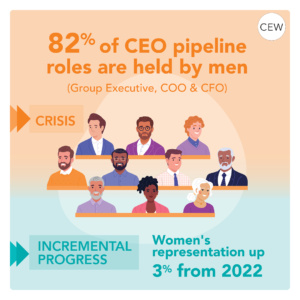
- Men hold 82% of CEO pipeline roles.
- 28 ASX300 companies have no women in their Executive Leadership Teams
- 13% of ASX 100 CEO roles are held by women and 20% of CEO ‘pipeline’ roles
- At the current rate of change it could take up to 50 years to reach gender parity in CEO roles
However, the 2023 data does show some silver lining:
- The performance of the ASX100 was a key driver of the improvements on last year’s census.
- 10 of the 42 CEO appointments on the ASX 300 went to women this year, compared to 4 of 28 in 2022
- The appointment of six additional female CEOs over the past years has resulted in a shift in gender parity expectations to 50 years from 100 years one year ago
There are 3 calls to action shared by CEW in their study:
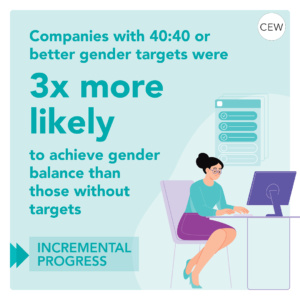
- Set a 40:40:20 by 2030 gender target with real accountability and transparency
- Invest in gender balanced CEO and ExecutiveLeadership Team Talent Pipelines
- Build inclusive, flexible and respectful workplaces
Status of Women Report 2023 by the Australian Government
Released on The International Women’s Day, this report gives a detailed view of “what life looks like for women in Australia in 2023”. The report looks at education, economic outcomes, health and safety, housing and gender norms.
We have summarised key stats around gender pay gap from the report:
- Australia is ranked 43rd for gender equality internationally
- A gender pay gap emerges immediately after graduation, full-time starting salaries average $69,000for men and $67,000 for women
- 55% drop in earningsfor the mother in the 5 years following childbirth, while men’s remains unchanged
- The full-time gender pay gap is a record low, but women still earn less on average.
-
- Hourly earnings pay gap: 11.6%
- Full-time weekly pay gap: 13.3%
- Total annual taxable income gap: 29.2%
- Women of all ages spend 9 hours a week more than men on unpaid work and care.
- Women: 31.6 hours
- Men: 22.4 hours
Women’s Economic Equality Taskforce (WEET) Report on Women’s Economic Equality
The Women’s Economic Equality Taskforce chaired by Sam Mostyn AO, is “an independent group established to provide advice to the government to support the advancement of women’s economic equality and achieve gender equality.”
They recently submitted their final report Women’s Economic Equality: A 10-year plan to unleash the full capacity and contribution of women to the Australian economy.
Here are some of the key findings of the taskforce on gender roles and attitudes in Australia that shares how Australia stands to gain $128 billion by unlocking women’s full and equal participation. Here are some of the current gaps that the report highlights:
- Women do the majority of formal care work, which is generally low paying — for example, 92 per cent of early childhood education and care workers are women
- Women spend 30.2 hours a week on unpaid care and housework, compared to 21.8 hours per week for men.
- Women accounted for the sole parent in 80.4 per cent of lone-parent families in 2021
- Employed women continue to work substantially less hours than men
- Motherhood penalty sees women’s earnings drop by 55 per cent on average during first five years of parenting their first child, while earnings remain unaffected for men during the same period.
- Women work an average 32.5 hours per week compared to 39.3 hours for men
- Women make up 70.4 per cent of the part time workforce
- Just 0.7 per cent of private-sector funding went to startups of sole women-founded companies in the 2022 financial year
- 30 per cent of Australian men don’t think gender inequality exists
- “If current working patterns continue, the average 25-year-old woman today, who has at least one child, can expect to earn $2 million less over lifetime than the average 25-year-old man who becomes a father.”
In a strong push to addressing gender pay gap, the govt. has now mandated Australian companies to share their gender pay data. As reported by the AHRI –
The Workplace Gender Equality Amendment (Closing the Gender Pay Gap) Bill 2023, which was introduced into Parliament on 8 February, will set out to publish the gender pay gap of organisations with 100 or more employees. Reporting will commence in 2024, and gender pay gap information will be published on the Workplace Gender Equality Agency (WGEA) website.
In some early research on the topic, there is a causation that has been discovered between gender diversity and profitability based on data from Australian workplaces.
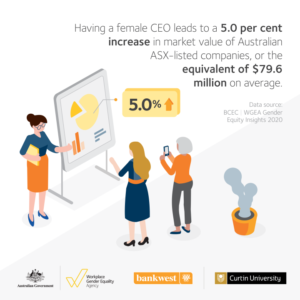
The WGEA’s research established that companies who appointed a female CEO increased their market value by five per cent – equivalent of $79.6 for an average ASX200 company
A report published by the Bankwest Curtin Economics Centre (BCEC) and the Workplace Gender Equality Agency (WGEA) found that an increase in the share of female ‘top-tier’ managers by 10 percentage points or more led to a 6.6 per cent increase in the market value of Australian ASX-listed companies, worth the equivalent of AUD$104.7 million. The other key findings included –
• The appointment of a female CEO led to a 12.9 per cent increase in the likelihood of outperforming the sector on three or more metrics
• An increase of 10 percentage points or more in the share of female key management personnel led to a 5.8 per cent increase in the likelihood of outperforming their sector on three or more metrics
Victoria’s Commission for Gender Equality in the Public Sector released its report titled Intersectionality at Work: Building a baseline on compounded gender inequality in the Victorian public sector
This is an important resource to understand gender equality gaps from an intersectional lens, looking at how women from First Nations, from CARM (Culturally and Racially Marginalised) apart from those with disability, of different ages, of LGBTQIA+ backgrounds experience gender equality at work.
It’s a crucial resource for all organisations especially in Public Sector at building an intersectional approach to their gender equality programs.
- Pay gaps ARE significant between culturally and racially marginalised (CARM) women and non-CARM men (19%)
- Only 3% of CARM women reported that they held a senior management role, and only 9% were in a supervisory position (compared with non-CARM men at 14% and 21% respectively).
- CARM women experience even worse leadership outcomes than other disadvantaged groups, such as First Nations women (with representation at 6% and 11% respectively)
- Pay gaps were largest between First Nations women when compared with non-Indigenous men, at 21% across all industries
- Women with disabilities experienced large pay gaps when compared with men without disabilities, at 19% across all industries
In a corporate landscape that continually struggles with gender equity, these data points act as a clarion call. In our next blog series, we will look at key data on linkages between strong women leadership and business outcomes. Stay tuned!
Discover which stage your organisation is in its Gender Equity Maturity. Download our latest report to take the assessment and get specific recommendations on how you can take your gender equity to the next level.