

There is a lot of buzz on the need for Women Leadership Development but on-ground there is a considerable discrepancy in promoting the advancement of women leaders, which contributes to their ongoing underrepresentation in the corporate arena.
This blog series is an attempt to aggregate and share data on how Corporate Australia lags in its Gender Equity efforts.
These statistics offer a comprehensive view of the underrepresentation of women in leadership roles and highlight the urgency for organisations to take action.
Key Data and Statistics on current trends in Women Leadership in Australia
CEW Senior Executive Census 2023
Now entering its seventh year, the CEW Senior Executive Census tracks the annual progress of women’s representation in Executive Leadership Teams in Australia’s top companies.
The 2023 findings show how women continue to stay underrepresented in Corporate Australia:
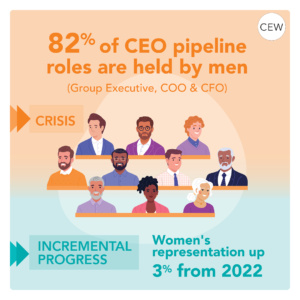
- 7 in 10 executive roles are held by men (71%) across ASX 300, with women’s representation up just 2% from 2022
- 9% of ASX300 CEO roles are held by women
- Men still hold 9 in 10 CEO roles at Australia’s largest companies – 91% of ASX300 CEOs are men.
- Only 23% of ASX300 companies have gender balanced leadership teams
- Men hold 82% of CEO pipeline roles.
- 28 ASX300 companies have no women in their Executive Leadership Teams
- 13% of ASX 100 CEO roles are held by women and 20% of CEO ‘pipeline’ roles
- At the current rate of change it could take up to 50 years to reach gender parity in CEO roles
However, the 2023 data does show some silver lining:
- The performance of the ASX100 was a key driver of the improvements on last year’s census.
- 10 of the 42 CEO appointments on the ASX 300 went to women this year, compared to 4 of 28 in 2022
- The appointment of six additional female CEOs over the past years has resulted in a shift in gender parity expectations to 50 years from 100 years one year ago
There are 3 calls to action shared by CEW in their study:
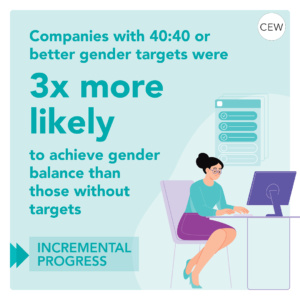
- Set a 40:40:20 by 2030 gender target with real accountability and transparency
- Invest in gender balanced CEO and ExecutiveLeadership Team Talent Pipelines
- Build inclusive, flexible and respectful workplaces
Status of Women Report 2023 by the Australian Government
Released on The International Women’s Day, this report gives a detailed view of “what life looks like for women in Australia in 2023”. The report looks at education, economic outcomes, health and safety, housing and gender norms.
We have summarised key stats around gender pay gap from the report:
- Australia is ranked 43rd for gender equality internationally
- A gender pay gap emerges immediately after graduation, full-time starting salaries average $69,000for men and $67,000 for women
- 55% drop in earningsfor the mother in the 5 years following childbirth, while men’s remains unchanged
- The full-time gender pay gap is a record low, but women still earn less on average.
-
- Hourly earnings pay gap: 11.6%
- Full-time weekly pay gap: 13.3%
- Total annual taxable income gap: 29.2%
- Women of all ages spend 9 hours a week more than men on unpaid work and care.
- Women: 31.6 hours
- Men: 22.4 hours
Women’s Economic Equality Taskforce (WEET) Report on Women’s Economic Equality
The Women’s Economic Equality Taskforce chaired by Sam Mostyn AO, is “an independent group established to provide advice to the government to support the advancement of women’s economic equality and achieve gender equality.”
They recently submitted their final report Women’s Economic Equality: A 10-year plan to unleash the full capacity and contribution of women to the Australian economy.
Here are some of the key findings of the taskforce on gender roles and attitudes in Australia that shares how Australia stands to gain $128 billion by unlocking women’s full and equal participation. Here are some of the current gaps that the report highlights:
- Women do the majority of formal care work, which is generally low paying — for example, 92 per cent of early childhood education and care workers are women
- Women spend 30.2 hours a week on unpaid care and housework, compared to 21.8 hours per week for men.
- Women accounted for the sole parent in 80.4 per cent of lone-parent families in 2021
- Employed women continue to work substantially less hours than men
- Motherhood penalty sees women’s earnings drop by 55 per cent on average during first five years of parenting their first child, while earnings remain unaffected for men during the same period.
- Women work an average 32.5 hours per week compared to 39.3 hours for men
- Women make up 70.4 per cent of the part time workforce
- Just 0.7 per cent of private-sector funding went to startups of sole women-founded companies in the 2022 financial year
- 30 per cent of Australian men don’t think gender inequality exists
- “If current working patterns continue, the average 25-year-old woman today, who has at least one child, can expect to earn $2 million less over lifetime than the average 25-year-old man who becomes a father.”
In a strong push to addressing gender pay gap, the govt. has now mandated Australian companies to share their gender pay data. As reported by the AHRI –
The Workplace Gender Equality Amendment (Closing the Gender Pay Gap) Bill 2023, which was introduced into Parliament on 8 February, will set out to publish the gender pay gap of organisations with 100 or more employees. Reporting will commence in 2024, and gender pay gap information will be published on the Workplace Gender Equality Agency (WGEA) website.
In some early research on the topic, there is a causation that has been discovered between gender diversity and profitability based on data from Australian workplaces.
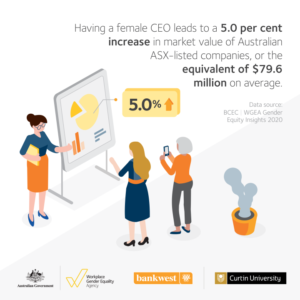
The WGEA’s research established that companies who appointed a female CEO increased their market value by five per cent – equivalent of $79.6 for an average ASX200 company
A report published by the Bankwest Curtin Economics Centre (BCEC) and the Workplace Gender Equality Agency (WGEA) found that an increase in the share of female ‘top-tier’ managers by 10 percentage points or more led to a 6.6 per cent increase in the market value of Australian ASX-listed companies, worth the equivalent of AUD$104.7 million. The other key findings included –
• The appointment of a female CEO led to a 12.9 per cent increase in the likelihood of outperforming the sector on three or more metrics
• An increase of 10 percentage points or more in the share of female key management personnel led to a 5.8 per cent increase in the likelihood of outperforming their sector on three or more metrics
Victoria’s Commission for Gender Equality in the Public Sector released its report titled Intersectionality at Work: Building a baseline on compounded gender inequality in the Victorian public sector
This is an important resource to understand gender equality gaps from an intersectional lens, looking at how women from First Nations, from CARM (Culturally and Racially Marginalised) apart from those with disability, of different ages, of LGBTQIA+ backgrounds experience gender equality at work.
It’s a crucial resource for all organisations especially in Public Sector at building an intersectional approach to their gender equality programs.
- Pay gaps ARE significant between culturally and racially marginalised (CARM) women and non-CARM men (19%)
- Only 3% of CARM women reported that they held a senior management role, and only 9% were in a supervisory position (compared with non-CARM men at 14% and 21% respectively).
- CARM women experience even worse leadership outcomes than other disadvantaged groups, such as First Nations women (with representation at 6% and 11% respectively)
- Pay gaps were largest between First Nations women when compared with non-Indigenous men, at 21% across all industries
- Women with disabilities experienced large pay gaps when compared with men without disabilities, at 19% across all industries
In a corporate landscape that continually struggles with gender equity, these data points act as a clarion call. In our next blog series, we will look at key data on linkages between strong women leadership and business outcomes. Stay tuned!
Discover which stage your organisation is in its Gender Equity Maturity. Download our latest report to take the assessment and get specific recommendations on how you can take your gender equity to the next level.